
The last time I wrote about the chickens, it was because our little splash Ameraucana, Plátano, was being bullied by the other birds.
I found the situation pretty stressful, but I am sure I was not nearly as distressed as she was. Banana Bread would start pecking her, pinning her to the ground, and then when she tried to run away, other birds, including our adult hens, would take stabs at her too. It was awful. We would help her escape to the coop, and then she spent the whole day on the roosting bar, hiding. We were in a heatwave with multiple days around 100°F, and I was worried that if she could only eat and drink at nightfall, when the drama quieted down, she was going to get sick or seriously hurt.

It’s the first time I have had to do first aid for a chicken. I was relieved that her only real wound was a small cut on her comb. I put some cornstarch on it to encourage clotting and treated it with both an antiseptic wipe from our emergency kit and triple-antibiotic ointment.
We couldn’t let the violence persist, though. We did some research, trying to determine what was going on (and trying to accept the possibility that the chickens might have to sort it out themselves). Julio decided that we should get some peepers for Banana Bread, since that bird appeared to be the instigator.
We opted for the pinless variety of peepers, which clip onto the bird’s head, resting in the nostrils, but do not require a pin to keep them in place. Initially, Banana Bread seemed irritated, but that was short-lived. Almost immediately, the violence toward Plátano stopped. It was amazing.
The next morning, Julio heard someone crow.
How to Spot a Rooster
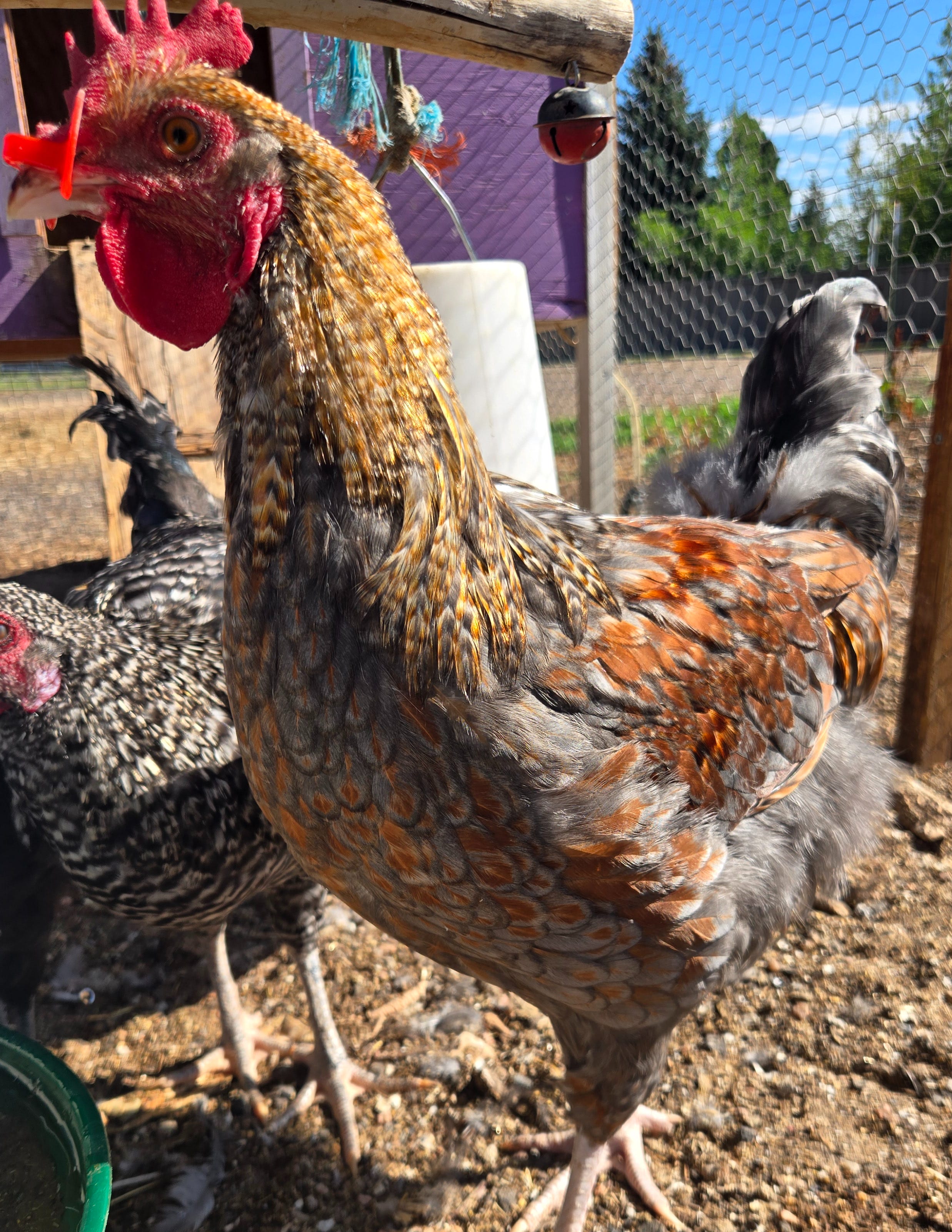
We have long suspected that Banana Bread was a rooster. For us, the major clues were, in chronological order:
Early development and reddening of comb and waddle
Thick legs
Pointy neck feathers (as opposed to the more rounded shape on a hen)
Strutting, more upright posture
The development of saddle feathers at the hip and a cascading plume-like tail


The problem for me was that, for the most part, when I looked at Banana Bread and I looked at Blackout, I saw the same traits. For more than a month, I kept telling my daughter, “I hope I’m wrong, but there’s a chance Blackout is a rooster.”
Then, I would watch Banana Bread and Blackout face off in a little hop-hop-hop confrontation, their neck feathers all ruffled, and they were so spiky. And I’d think, hopefully I’m wrong, but I don’t think I am.
Two days after the peepers were put on Banana Bread, one day after he heard the first attempt at a cockle-doodle-doo, Julio heard a much clearer crow and saw that it came from Blackout. Our girl’s favorite girl was a boy. Many tears were shed.
Roosters & The Pecking Order
A rooster is not included in the hens’ pecking order. He is the hens’ first line of defense and often allows the girls to eat and drink before him. Roosters can be gentlemen in addition to their dueling, cocky nature. Julio noticed that the other birds were orienting around Banana Bread in the coop, like his harem. Although roosters may duel with each other, they are usually not violent toward hens except to break up fights. Unless they are young roos and are trying to mate and the young hens are resistant. We think that’s what was really going on with Plátano and Banana Bread.
A Sad Farewell to the Roos
On Saturday, we packed Banana Bread and Blackout up for a little road trip to Serenity Sprouts, the hatchery where their eggs came from. There, the boys will either get rehomed to a family in need of a roo, or join the Gentlemen’s Club. They will be missed by us, if not by Plátano. It was fun getting to see them grow.


So, that leaves our Kindergarten flock with Lucky (who has been enjoying the swing—see the video below), Plátano, Honey Bee, and Cookie. But per my daughter’s wish, we are probably going to change Cookie’s name to Blackout, since she is all black and also chickens don’t seem to know their names.
I took the opportunity to ask the owner of Serenity Sprouts what type of chickens he thinks Banana Bread and Blackout are. He said that, without seeing the hen they came from or the eggs, his first guess would be Wellsummer and Barred Plymouth Rock. We now know that the eggs included in hatching kits are blue and green, so that probably confirms my hunch that Honey Bee is an olive egger. We’ll see in about a month when the little hens start laying eggs.

Do you have a rooster? Do you have a favorite among our birds? Let us know in the comments. Mine is Lucky
Roosters can be mean. I am so glad you were able to rehome them. I take all mine to live out at the old farm. By the workshop - they are free, get fed daily and out there without any hens around seem to live quite happily. Plus keep the mice down around the grain bins. But they are so beautiful and guard the hens well so I always keep one for each hen house.
The first thing that zipped through my brain when I saw the photo of the Roos with their neck feathers out was the little dino with the frill that jumps out and sprays venom in someone’s eyes in Jurassic Park.