
Be a Tree
Bonus points if it's on Public Lands
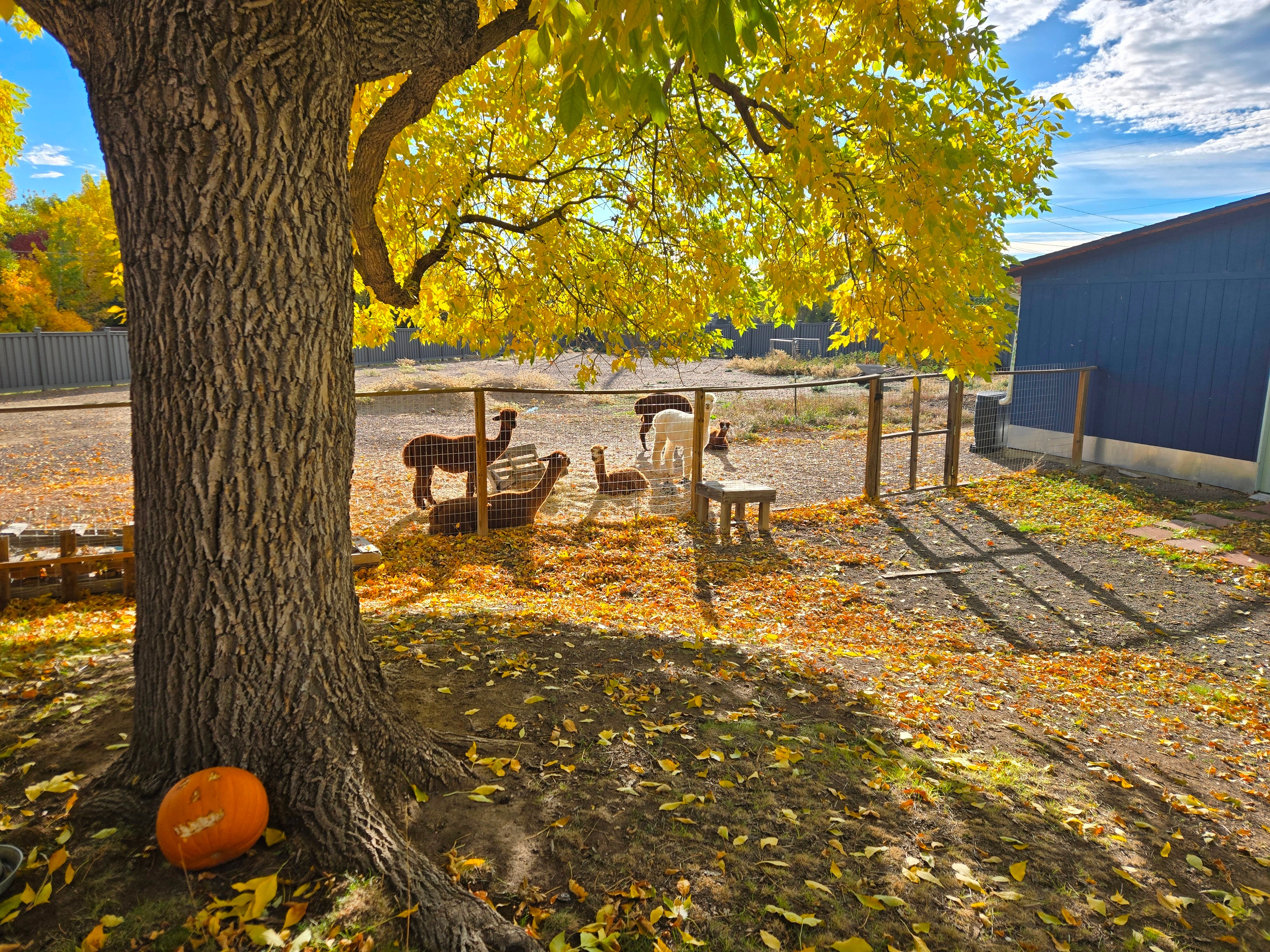
As I write this, a crew is trimming our trees. It’s all chainsaws and curious alpacas and branches everywhere. I’m watching one of the guys out on a limb and wondering if this is a top career choice for kids who like to climb trees.
My husband has to keep reminding me that this is healthy. It’s good for the trees. I know he is right, and my eyes will adjust, but right now all I can see is the open space where one of my favorite branches was, overhanging the fence between the pasture and our yard. It was so lovely in Autumn. It might have eventually knocked down the fence, but I don’t care about that right now. Now, I’m just noticing how my view has changed. Alas.
A couple of weeks ago, we got a heavy, wet snowfall that damaged trees in our area. We lost several big branches, but fortunately, none landed on anything other than the ground. That accelerated our plan to have the trees trimmed, but for a morning, our alpacas were happy that they could reach leaves that normally fluttered above their heads.
To me, there is something about a full-grown tree that seems eternal. But one of the trees in our yard is threatening to die. Quick, I think, we'd better plant another tree so it can start growing now. So we can have shade again soon.
A full-grown tree is sort of irreplaceable. At least in the near future. The timescale is on a different order than many of my concerns.
It’s maybe an unwelcome reminder of how long it can take good things to develop, how quickly they can be destroyed, and how much they will be missed when they are gone. In our time, I feel like we’ve been getting reminders like that all too often.
Chainsaws and dead branches. But sometimes you need to prune to grow.
My friend Keaton loves the “Be a Tree” meditation. I’m trying it while I listen to the dead limbs outside move through a chipper. It’s discordant, but valuable. There are many variations of this meditation, but it goes like this:
Be a Tree
Close your eyes and plant your feet firmly beneath you. Stand with your arms relaxed at your side. Or maybe get a little playful and extend them out like branches.
Take deep, centering breaths. In and out slowly.
As you find your center, imagine that your feet are roots holding you to the spot where you stand. What does the ground feel like beneath you? Do you feel stable? Are you swaying as if in the breeze?
As you feel grounded, become aware of the world around you. What do you hear? What do you smell? What can you feel? Be where you are. Be a tree, fully present in the here and now.
Take more deep breaths. Noticing the air around you.
Visualize yourself as a tree. What kind of tree are you? What season is it? Are you home to a squirrel or bird? What is the weather like?
Emotionally, take a step back. How are your branches doing? Do your limbs feel strong? Are your roots, xylem, and phloem drawing up the nourishment they need?
Do any of your branches need to be pruned? Are there parts of your tree that feel undernourished, heavy, or dead? Let these branches go. Come back to your roots. Feel yourself grounded, lighter from the pruning.
Take more deep breaths. Come back to the visualization of the natural world around you, a tree. Come back to noticing. What do you feel? hear? smell? What is the energy of the air around you? Stay in this moment for four more breath cycles, then open your eyes.
Speak for Public Lands
Last week, the Trump Administration rescinded the Bureau of Land Management’s Public Lands Rule that made conservation a legal use of federal public lands. It’s another blow in the ongoing fight to protect our Public Lands, National Parks and Forests, and the legacy of conservation that Americans have treasured for generations.
As the National Parks Conservation Association puts it, “This move upends a balanced land management approach away from accounting for wildlife conservation, cultural resource protection and recreational use in favor of expanded oil and gas drilling, mining and industrial development on millions of acres of public lands as part of a broader push to sell off public lands to private interests.”
Per Defenders of Wildlife, the BLM oversees 245 million acres of Public Lands, one in ten acres in the U.S., and home to 300 threatened and endangered species. They point out: “Currently, 81% of the National System of Public Lands is open to oil and gas drilling, and approximately 60% are grazed by livestock, while only 14% are designated for enduring conservation. Decades of BLM management that has focused on extraction and resource development have contributed to the degradation of habitats and landscapes, leaving them less resilient and increasingly vulnerable to compounding pressures.”
So, Be a Tree. Imagine you are a tree on Public Lands. Or, go to Public Lands near you, and repeat this exercise. Then raise your voice for those trees and the species (including us) who depend on them.
Colorado Senator Michael Bennet has introduced legislation to try to prevent the sale of public lands. You might call your elected officials and ask them to support the measure and what they are doing to protect our public lands from mining and development as well.
Further Reading
Collecting Fabulous Trees in Wild Roof Journal, January 2025

Old Growth: The Best Writing About Trees From Orion
Finding the Mother Tree: Discovering the Wisdom of the Forest by Suzanne Simard
When Trees Testify: Science, Wisdom, History, and America’s Black Botanical Legacy by Beronda L. Montgomery
The Hidden Life of Trees: What They Feel, How They Communicate--Discoveries from a Secret World by Peter Wohlleben